i don't really want to sum up my experience or talk about how i've grown/ questioned/ challenged myself or anything like that.
i'll relate some other research to you that i've been doing instead, i think that will be more productive and interesting for all of us.
-there's this original content blog i want you all to be aware of called the jogging. it's run buy a team of insufferably smart kids who obviously study a whole lot of critical theory and get huge boners in the process.
http://thejogging.tumblr.com/
anyway, they're relevant to this course in that they have this project running at the moment called 'assembly' where they get all their digital followers/ peers to critique/ undermine/ sabotage an individual or institutions website by 'bandwidth squatting' (getting everyone to open a million tabs of the targetted website until it goes bust). the way they have contextualised this activity is as
"a detournement of digital visitation.", where "through their undesired mass presence, protesters are able to disrupt the informational function of the website they are intervening on"
its quite nifty, but also incredibly annoying.
-i read an interesting article in the new yorker yesterday about how digital/ online activism will never amount to have the same kind of impact of say the civil rights movement of the 1960s despite having millions of people 'like' their cause, or retweet a particular injustice, or donate one cent per post or whatever. the logic of the article was that in order for radical activism to be effective, it needs to rely on hierachical streamlined power structures with strong-tie connections between the members, rather than diffuse, horizonatally organized weak-tie networks online.
it was called 'why the revolution will not be tweeted'.
lolololololol
i haven't read that 'communites of sense' article yet. i might.
Showing posts with label Alex Mckenzie. Show all posts
Showing posts with label Alex Mckenzie. Show all posts
Sunday, October 24, 2010

Sunday, October 17, 2010
p.s.
i really like the way that mind map is split up into 'interractions' and 'products'
i also like how the products are also both material and immaterial.
i also like how the products are also both material and immaterial.
john peel's perfumed garden
(title irrelevant)
looking at that old photo of kirkbride kind of blew me away. that is to say that it blew me as far in any one direction as an archival 19th century black and white photograph of the mental institution where i now go to school possibly could. what i mean to say, is that its incredible how lush and built up that space seemed, to have those big trees and palms just growing there make the environment look so much less barren and more inviting. so my question is this: how come its not even more overgrown, or developed up than that now? what happened to all the vegetation? did it just die out one hot summer, or not get maintained, or perhaps get over maintained?
this is something i've noticed in sydney that tends (haw haw haw, tends) to happen a lot, that they cut the grass so short and so often that it just sort of becomes this crisply baked yellow-green dessert of grass, as opposed to places ive been to like berlin, where stuff just sort of goes a little bit wild and seems to do the better for it.
have you noticed that more chains have gone up around the canteen at school? no more cutting that corner, sneaky art students. whats the deal with that? are we not meant to be enjoying that little expanse of grass? when stuff like that happens i find it concerning: in that the green areas of vegetation around our living environs become these sorts of 'machines for leisure', or 'machines for viewing-pleasure', in a very strict and structured Le Corbusier kind of way.
two points:
-the door to the space where the garden is should probably be left unlocked, i've tried a couple of times to have a look/ "interact" but to no avail
-i really love houseplants
looking at that old photo of kirkbride kind of blew me away. that is to say that it blew me as far in any one direction as an archival 19th century black and white photograph of the mental institution where i now go to school possibly could. what i mean to say, is that its incredible how lush and built up that space seemed, to have those big trees and palms just growing there make the environment look so much less barren and more inviting. so my question is this: how come its not even more overgrown, or developed up than that now? what happened to all the vegetation? did it just die out one hot summer, or not get maintained, or perhaps get over maintained?
this is something i've noticed in sydney that tends (haw haw haw, tends) to happen a lot, that they cut the grass so short and so often that it just sort of becomes this crisply baked yellow-green dessert of grass, as opposed to places ive been to like berlin, where stuff just sort of goes a little bit wild and seems to do the better for it.
have you noticed that more chains have gone up around the canteen at school? no more cutting that corner, sneaky art students. whats the deal with that? are we not meant to be enjoying that little expanse of grass? when stuff like that happens i find it concerning: in that the green areas of vegetation around our living environs become these sorts of 'machines for leisure', or 'machines for viewing-pleasure', in a very strict and structured Le Corbusier kind of way.
two points:
-the door to the space where the garden is should probably be left unlocked, i've tried a couple of times to have a look/ "interact" but to no avail
-i really love houseplants
Saturday, October 9, 2010
9/11 as a meme
if you want a lol reread the first two pages of the ambient spectacle article and replace 9/11 with 'lady gaga meat dress'.
Saturday, September 18, 2010
do the tightrope
no, i'm not talking about the beautiful beets of Janelle Monae, though i do think her hair worthy of a symphony, i'm talking about Phillipe Petit.
i figured i'd pen my post this week on the pretty incredible high-wire tight-rope walking between the erstwhile twin towers of the world trade centers because a documentary that deals with this event in immense detail and depth, Man on Wire was aired on SBS on wednesday or tuesday night of this week, and though i tuned in halfway through the screening, i was so captivated that i didnt even have time to get my cheese toastie from the kitchen.
i'll surmise the plot of the event for you readers who are unaware or unfamiliar with it. Phillipe Petit was a french high-wire artist born in 1942 who was obsessed with the public act of tight-rope performances on urban structures. he started with streetlamps, worked his way upto notre dame and upon seeing plans of the construction of the twin towers as he waited in his dentist's office became fixated upon the notion of traversing them on a cable.
this act he achieved on the seventh of august, 1974, an act Phillipe and his group of collaborators (or, given the heightened illegality and conspicuousness of this performance, perhaps co-conspirators is a slightly more apt term) referred to as 'le coup'. It was a feat of orginization and the culmination of a lifetime of training and preparation, it utilized a behemoth 200 kg cable and custom-made 7.9 m long 25 kg balancing pole.

more than the story of how he executed this 'coup', a narrative delivered to place you on tenterhooks, i was more interested in how his girlfriend at the time described the act from the plaza at the ground of the twin towers, and looking at the performance from a relational perspective.
she was so moved by the beauty of this act, that she described as a 'gift' to new york, and the way that he quickly became this kind of 'celebrity' of sorts amongst the people of new york who looked at his tight-rope walk as a 'breath of fresh air', something that whimsically reimagined the fabric of the city as a space for living and working by transcending all barriers and definitions as a kind of miracle or vision.
this is heightened by the fact that viewers on the ground or in other buildings often could not see the wire, only the man, floating like a mirage or a vision against the sky.
its pretty captivating stuff. especially when you think that now that the twin towers are gone this act is almost completely buried, or rather, completely and definitively unrepeatable, its just air, negative space up there now, but the thought of it (or how the thought of it was edited in this documentary) still kind of gave me goosebumps/ butterflies in my stomach.
what do you guys think?
i figured i'd pen my post this week on the pretty incredible high-wire tight-rope walking between the erstwhile twin towers of the world trade centers because a documentary that deals with this event in immense detail and depth, Man on Wire was aired on SBS on wednesday or tuesday night of this week, and though i tuned in halfway through the screening, i was so captivated that i didnt even have time to get my cheese toastie from the kitchen.
i'll surmise the plot of the event for you readers who are unaware or unfamiliar with it. Phillipe Petit was a french high-wire artist born in 1942 who was obsessed with the public act of tight-rope performances on urban structures. he started with streetlamps, worked his way upto notre dame and upon seeing plans of the construction of the twin towers as he waited in his dentist's office became fixated upon the notion of traversing them on a cable.
this act he achieved on the seventh of august, 1974, an act Phillipe and his group of collaborators (or, given the heightened illegality and conspicuousness of this performance, perhaps co-conspirators is a slightly more apt term) referred to as 'le coup'. It was a feat of orginization and the culmination of a lifetime of training and preparation, it utilized a behemoth 200 kg cable and custom-made 7.9 m long 25 kg balancing pole.
more than the story of how he executed this 'coup', a narrative delivered to place you on tenterhooks, i was more interested in how his girlfriend at the time described the act from the plaza at the ground of the twin towers, and looking at the performance from a relational perspective.
she was so moved by the beauty of this act, that she described as a 'gift' to new york, and the way that he quickly became this kind of 'celebrity' of sorts amongst the people of new york who looked at his tight-rope walk as a 'breath of fresh air', something that whimsically reimagined the fabric of the city as a space for living and working by transcending all barriers and definitions as a kind of miracle or vision.
this is heightened by the fact that viewers on the ground or in other buildings often could not see the wire, only the man, floating like a mirage or a vision against the sky.
its pretty captivating stuff. especially when you think that now that the twin towers are gone this act is almost completely buried, or rather, completely and definitively unrepeatable, its just air, negative space up there now, but the thought of it (or how the thought of it was edited in this documentary) still kind of gave me goosebumps/ butterflies in my stomach.
what do you guys think?
Sunday, September 12, 2010
seating and shade
seating and shade
seating and shade
i like the way that in the reading this week, the fragment from Miwon Kwon's One Place After Another talks about this idea of site specifity in public art projects and this notion that the artworks installed in the plazas and squares and inbetween spaces of the city are there not just as 'architectural jewelry' but to serve an active purpose that encourages use by the community and hence a vital place within the fabric of the city.
so, pretty much we sit on them.
i don't really know what else you can do with a sculpture to be honest apart from sit on it or look at it.
i mean, who wouldn't want this pointy rusty thing by Richard Serra in their forum, neighbourhood park, community center plaza, backyard etc. i guess with this particular work you can walk into a small, claustrophobic space and hang out. just think what kind of sordid, delinquent activites would take place in there after dark. maybe at nightfall it could convert its inards into a large urinal, and engage with the intoxicated passers by who feel the urge to relieve themselves but find around them only cold exposoed commercial spaces of metal and glass sheets.
i think the mere fact that richard serra's controversial tilted arc provoked such a strong reaction in the public is quite possibly what one could argue makes it a success in that it encouraged, or rather, smacked people out of their torpor and forced them to consider the ideological and psychological class based undercurrents at play within the concreted topographies of the urban landscape.
there's this public arts work in london thats been going on for a couple of years in trafalgar square. theres this so called 'fourth plinth' there, that was designed to hold a statue for a monarch who didnt have enough money after he died for the statue to actually be built. since then (sometime in the 19th century) its been left bare, and since the mid 90s, artists of note have been asked to install temporary works upon it.
rachel whiteread did one.
http://www.london.gov.uk/fourthplinth/
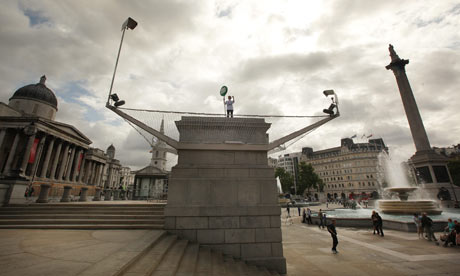
the one pictured was by this guy where people were allowed to go up onto the plinth via cherry picker and yell whatever they wanted down.
its cool and relavent i guess, mainly becuase its a performative based public artwork.
lolol.
seating and shade
i like the way that in the reading this week, the fragment from Miwon Kwon's One Place After Another talks about this idea of site specifity in public art projects and this notion that the artworks installed in the plazas and squares and inbetween spaces of the city are there not just as 'architectural jewelry' but to serve an active purpose that encourages use by the community and hence a vital place within the fabric of the city.
so, pretty much we sit on them.
i don't really know what else you can do with a sculpture to be honest apart from sit on it or look at it.
i mean, who wouldn't want this pointy rusty thing by Richard Serra in their forum, neighbourhood park, community center plaza, backyard etc. i guess with this particular work you can walk into a small, claustrophobic space and hang out. just think what kind of sordid, delinquent activites would take place in there after dark. maybe at nightfall it could convert its inards into a large urinal, and engage with the intoxicated passers by who feel the urge to relieve themselves but find around them only cold exposoed commercial spaces of metal and glass sheets.
i think the mere fact that richard serra's controversial tilted arc provoked such a strong reaction in the public is quite possibly what one could argue makes it a success in that it encouraged, or rather, smacked people out of their torpor and forced them to consider the ideological and psychological class based undercurrents at play within the concreted topographies of the urban landscape.
there's this public arts work in london thats been going on for a couple of years in trafalgar square. theres this so called 'fourth plinth' there, that was designed to hold a statue for a monarch who didnt have enough money after he died for the statue to actually be built. since then (sometime in the 19th century) its been left bare, and since the mid 90s, artists of note have been asked to install temporary works upon it.
rachel whiteread did one.
http://www.london.gov.uk/fourthplinth/
the one pictured was by this guy where people were allowed to go up onto the plinth via cherry picker and yell whatever they wanted down.
its cool and relavent i guess, mainly becuase its a performative based public artwork.
lolol.
Saturday, August 28, 2010
... we need to talk ...
personally, this was an impeccably well timed reading. (i am referring to the hand-out we were given, the introduction to Conversation Pieces, by Grant H. Kester. By that statement, what i mean is that, rather than posit the notion of discursive or dialogical art, or relational aesthetics and hitting the ground running as it were, Kester approaches this contemporary artistic tendency whilst providing it, or perhaps, foreshadowing it against traditional art-object based practices and theory.
this was incredibly helpful for me, because the problems that he laid out that traditional critics had in approaching art works like the roof is on fire which stimulate the creation of temporal collaberative dialogues and exchange within the public sphere are the exact same problems or frustrations that i was experiencing.
By which i mean: the results of these enterprises are often completely unaesthetic, or stimulate little to no visual pleasure, and hence, on that level can be seen as unengaging, or 'fluffy'
also: that these works are very difficult to distinguish from other activities within the broader social and political spheres of activity or demonstration in a certain city or country.
what i loved about this reading is how he Grant drew out links between many of the ultimate goals of so called 'traditional' modernist object art with those of relational art.
these being a "kind of epiphany that lifts viewers outside the familiar boundaries of a common language, existing modes of representation, and even their own sense of self." (pp 12)
but instead of attempting to achieve this through the 'shock', or blow of a single, object or image, it attempts to achieve this through " a cumulative process of exchange and dialogue."
question: what does 'Greenbergian' mean? so i can understand what 'post-Greenbergian' means. . .

on a brief note, i just checked out the website for the danish collective called superflux that was mentioned in the reading. they put on this show called 'FREE BEER', which "applies modern free software / open source methods to a traditional real-world product - namely the alcoholic beverage loved and enjoyed globally, and commonly known as beer."
exactly how they apply these 'open source methods' to beer is slightly unclear to me, i think maybe they all got together and brewed beer, and shared recipes and ideas for different brews?

i like that this project is still very colourful and aesthetically pleasing and well organised, and still exisiting within an institution.
but, more importantly, imagine how successful your opening night would be if your show was called 'FREE BEER'...
this was incredibly helpful for me, because the problems that he laid out that traditional critics had in approaching art works like the roof is on fire which stimulate the creation of temporal collaberative dialogues and exchange within the public sphere are the exact same problems or frustrations that i was experiencing.
By which i mean: the results of these enterprises are often completely unaesthetic, or stimulate little to no visual pleasure, and hence, on that level can be seen as unengaging, or 'fluffy'
also: that these works are very difficult to distinguish from other activities within the broader social and political spheres of activity or demonstration in a certain city or country.
what i loved about this reading is how he Grant drew out links between many of the ultimate goals of so called 'traditional' modernist object art with those of relational art.
these being a "kind of epiphany that lifts viewers outside the familiar boundaries of a common language, existing modes of representation, and even their own sense of self." (pp 12)
but instead of attempting to achieve this through the 'shock', or blow of a single, object or image, it attempts to achieve this through " a cumulative process of exchange and dialogue."
question: what does 'Greenbergian' mean? so i can understand what 'post-Greenbergian' means. . .
on a brief note, i just checked out the website for the danish collective called superflux that was mentioned in the reading. they put on this show called 'FREE BEER', which "applies modern free software / open source methods to a traditional real-world product - namely the alcoholic beverage loved and enjoyed globally, and commonly known as beer."
exactly how they apply these 'open source methods' to beer is slightly unclear to me, i think maybe they all got together and brewed beer, and shared recipes and ideas for different brews?
i like that this project is still very colourful and aesthetically pleasing and well organised, and still exisiting within an institution.
but, more importantly, imagine how successful your opening night would be if your show was called 'FREE BEER'...
Sunday, August 22, 2010
location location situation
i'm glad with the fact that it seems like a lot of people were a bit peeved by the fact that, (something that Raunig commented on in the reading on the situationst international that most people seemed to choose to focus their attention on this week) there is very little work, or anything that seemed to precipitate out of all of this philosphical creeds and manifestoes and political theories.
It felt a bit like when i made esthers in year nine science: you set up this huge interconnected mad scientist set-up of beakers and volumetric flasks bubbling away on bunsen burners and connected by rubber seals and plastic tubes, spend half an hour measuring out chemicals and in the end there's this one foot condensing tube and down it trickle two or three drops of your esther and you say to yourself 'all that for this?'
i guess i just find myself a little bit frustrated or perhaps just grumps when there arent any nice pictures or illustrations to accompany the text.

"STAY YOUNG AND SHUT UP"
Putting that aside though, i tried to do a little bit more research into the situationist international to see if i could find some more examples of where there ideas actually 'precipitated' as it were. i found that in may 1968 in paris there was this huge demonstration/ revolts/ protests/'general wild cat strikes' (i think i like that last one the best) which culminated in the biggest general strike in a developed country.
ever.
I think that it's important to place the ethos of the situationist international in the context of the social tumult and general sense of upheaval at the time. If you've ever seen that horrible film 'the dreamers' or, (something with a bit more academic cred.)'La Chinoise' by Jean Luc-Godard, you'll get a sense for how exciting those days were. So i guess i'm trying to justify or to undercut my sense of frustration with this reading, by in a sense understanding where it came from.
It felt a bit like when i made esthers in year nine science: you set up this huge interconnected mad scientist set-up of beakers and volumetric flasks bubbling away on bunsen burners and connected by rubber seals and plastic tubes, spend half an hour measuring out chemicals and in the end there's this one foot condensing tube and down it trickle two or three drops of your esther and you say to yourself 'all that for this?'
i guess i just find myself a little bit frustrated or perhaps just grumps when there arent any nice pictures or illustrations to accompany the text.
"STAY YOUNG AND SHUT UP"
Putting that aside though, i tried to do a little bit more research into the situationist international to see if i could find some more examples of where there ideas actually 'precipitated' as it were. i found that in may 1968 in paris there was this huge demonstration/ revolts/ protests/'general wild cat strikes' (i think i like that last one the best) which culminated in the biggest general strike in a developed country.
ever.
I think that it's important to place the ethos of the situationist international in the context of the social tumult and general sense of upheaval at the time. If you've ever seen that horrible film 'the dreamers' or, (something with a bit more academic cred.)'La Chinoise' by Jean Luc-Godard, you'll get a sense for how exciting those days were. So i guess i'm trying to justify or to undercut my sense of frustration with this reading, by in a sense understanding where it came from.
Sunday, August 15, 2010
institutional stultification
i looked at Aberto and Stimson's Institutional Critique: An Anthology of Artists’ Writings(Cambridge, Mass: MIT Press, 2009)and it called to mind a quotation by Paul Valery that i found in Adam Geczy's book art, histories theories and exceptions
it reads thus:
"There is much that is admirable about them, but nothing delightful. Ideas of public order, conservation and public utility, exact and clear as they may be, have little to do with delight. [...] Upon my first step towards the things of beauty, a hand takes my cane, a notice tells me not to smoke.
Already numbed by authority and feeling constricted, i make my way into a room full of scuplture where nothing reigns but cold confusion. [...] I am within a tumult of frozen creatures, each of which recquires but is not affored, inexistence of the other"
I was completely dumbfounded by this quotation, can you believe it was written in 1923? i think i have this experience every single time i ascend the steps to the sandstone sepulchure of the AGNSW. I think its interesting to look at the agents of control and power within the gallery institution as Alberro does, because i think it can be easy to forget the idea of having to ask yourself, "who has bought and collected these works, for what purpose, and who, or what kind of person's eyes are they inted to be seen by?"
I often have a heightened awareness of these issues around Archibald time, or for that matter, any large time there is a prize involved. You have to wonder why that particular artwork was chosen, and it comes down to this strange breakdown of all these different factors that you can take into account.
It's funny, but this reminds me of a statistic i read about the salaries that Drew Barrymore, Cameron Diaz and Lucy Liu received for acting in the Charlies Angels sequel. Diaz got something like 23 million, Barrymore got 15 and Liu got a measly 6 or thereabouts. Knowing those figures and then watching the film you have to wonder what elements or traits these actors have and which of them get the bucks.
anyway, that was just an aside.
Despite the idea of galleries being hypocritical in the sense that they liquidate or stultify the very thing that it tries to enshrine or promote, i think that they are still great institutions that i am glad to have within the fabric of the city. They provide a context through which engage with the works and have art experiences of a level that we wouldnt otherwise.
i guess maybe instead of just carpet bomb attacks on the art-institution we should sort of campaign for an increased kind of transparancy of the power structures and individuals within and behind them, and perhaps to try and open them up and in a sense to democratise them?
(if thats a verb)
it reads thus:
"There is much that is admirable about them, but nothing delightful. Ideas of public order, conservation and public utility, exact and clear as they may be, have little to do with delight. [...] Upon my first step towards the things of beauty, a hand takes my cane, a notice tells me not to smoke.
Already numbed by authority and feeling constricted, i make my way into a room full of scuplture where nothing reigns but cold confusion. [...] I am within a tumult of frozen creatures, each of which recquires but is not affored, inexistence of the other"
I was completely dumbfounded by this quotation, can you believe it was written in 1923? i think i have this experience every single time i ascend the steps to the sandstone sepulchure of the AGNSW. I think its interesting to look at the agents of control and power within the gallery institution as Alberro does, because i think it can be easy to forget the idea of having to ask yourself, "who has bought and collected these works, for what purpose, and who, or what kind of person's eyes are they inted to be seen by?"
I often have a heightened awareness of these issues around Archibald time, or for that matter, any large time there is a prize involved. You have to wonder why that particular artwork was chosen, and it comes down to this strange breakdown of all these different factors that you can take into account.
It's funny, but this reminds me of a statistic i read about the salaries that Drew Barrymore, Cameron Diaz and Lucy Liu received for acting in the Charlies Angels sequel. Diaz got something like 23 million, Barrymore got 15 and Liu got a measly 6 or thereabouts. Knowing those figures and then watching the film you have to wonder what elements or traits these actors have and which of them get the bucks.
anyway, that was just an aside.
Despite the idea of galleries being hypocritical in the sense that they liquidate or stultify the very thing that it tries to enshrine or promote, i think that they are still great institutions that i am glad to have within the fabric of the city. They provide a context through which engage with the works and have art experiences of a level that we wouldnt otherwise.
i guess maybe instead of just carpet bomb attacks on the art-institution we should sort of campaign for an increased kind of transparancy of the power structures and individuals within and behind them, and perhaps to try and open them up and in a sense to democratise them?
(if thats a verb)
Wednesday, August 11, 2010
BOOM
we're not the only ones who are struggling to define what is art.
"freshtildeathonline" looks at a re-enactment of a seminal performance piece by Marina Abramovic at Moma.
"freshtildeathonline" looks at a re-enactment of a seminal performance piece by Marina Abramovic at Moma.
Sunday, August 8, 2010
arty (f)arty (or: i miss passivity)
``discursivity ``
`
~sociability~
"these artists aim to turn passive viewers into a temporary community of active interlocutors"
-Hal Foster, arty party, pp21
i guess you could say i'm tired of being a collaborative element in artworks, maybe i'm interactive weary; against all my better judgement i find myself feeling skeptical towards the almost utopic vision of interactivity and sociability that some contemporary artists and critics seem to tout as a'final soulution' of sorts to art practice.
what if you don't really feel like being in another community? we're already in a million of them in facebook and tumblr and flickr and grindr.
Let's take a step back, though. The notion of opening up the realms of the art-space from a binary kind of production of viewer and producer into a diffused environment of sociability and discursivity are certainly admirable ideals. I guess what i'm trying to put forward is a notion of what's potentially at stake for proponing these goals as the final destination, and that they can have the inverse affect of being read as simply confusing and alienating.
I think what i've worded poorly is a concern that Foster elecidates in his ironic reassessment of the Barthesian 'death of the author' not resulting so much in the birth of the reader but the "befuddlement of the viewer" (pp22)
I would love to look at what it means to be living in a 'post-critical' culture in class.
`
~sociability~
"these artists aim to turn passive viewers into a temporary community of active interlocutors"
-Hal Foster, arty party, pp21
i guess you could say i'm tired of being a collaborative element in artworks, maybe i'm interactive weary; against all my better judgement i find myself feeling skeptical towards the almost utopic vision of interactivity and sociability that some contemporary artists and critics seem to tout as a'final soulution' of sorts to art practice.
what if you don't really feel like being in another community? we're already in a million of them in facebook and tumblr and flickr and grindr.
Let's take a step back, though. The notion of opening up the realms of the art-space from a binary kind of production of viewer and producer into a diffused environment of sociability and discursivity are certainly admirable ideals. I guess what i'm trying to put forward is a notion of what's potentially at stake for proponing these goals as the final destination, and that they can have the inverse affect of being read as simply confusing and alienating.
I think what i've worded poorly is a concern that Foster elecidates in his ironic reassessment of the Barthesian 'death of the author' not resulting so much in the birth of the reader but the "befuddlement of the viewer" (pp22)
I would love to look at what it means to be living in a 'post-critical' culture in class.
Subscribe to:
Posts (Atom)