Showing posts with label carmel wellburn. Show all posts

Saturday, October 16, 2010

G.E.

Happy Eating

It is very clever of man to be the sole god like controller of ALL things, but where does man stop. I will go a bit off beat about this week’s topic and hope it will fit in somewhere.
What caught my eye was Monsanto the U.S. based multinational agricultural biotechnology corporation and two words; genetically engineered (GE).

I recently saw Janet Tavener’s exhibition ‘Out of the mould' at Vaucluse House. I will rely on Tracey Clement’s review in The Post Post to explain;

'If, as the old saying goes, “You are what you eat”, then artist Janet Tavener shows us that what we are is highly mediated, chemically coloured and genetically dumbed down. In her solo show, Out of the Mould, Tavener presents a suite of cast resin objects in the sumptuous drawing room at Vaucluse House. Some mimic transparent jellies while others take on the shape of fruit and veggies from the heirloom garden.
Despite utilising the setting of a genuine Historic Houses Trust landmark, a stunning location redolent of genteel elegance and charm, Tavener isn’t just gazing back on the past through rose coloured glasses. The artist is keenly aware that man’s desire to dominate nature isn’t a new phenomenon.

Tavener’s casts of heirloom produce look unfamiliar to modern eyes; the old fruits and veggies were weirder, wonkier, bigger and smaller. Her works draw attention to the fact that we have deliberately changed the shape and flavour of our food through selective breeding over thousands of years; a process of genetic manipulation which has accelerated rapidly in the last few centuries, and gone super-sonic in recent decades with the advent of gene splicing techniques.
By focusing on old varieties of fruit and vegetables (tiny strawberries, a miniature pineapple, a massive round zucchini which resembles a medieval cap, huge knobbly lemons) Tavener points out that through our attempts to control nature we have sacrificed diversity for homogeneity, quality for quantity and tenacity for predictability. Not a great plan in the long term. Back in the day, all farmers were organic farmers. The old plants may not have been gorgeous, but they were tough, unlike the massive monoculture crops of today which can’t seem to survive without regular dosing with a vast array of chemicals.

Tracey Clement

So what about those tiny strawberries in the Vaucluse House? They have gone, and in their place are our super-sonic ones.

'Genetic engineering is a new technology that combines genes from totally unrelated species, in combinations not possible using conventional breeding methods. Genes from an animal, say, a fish, can be put into a plant, a strawberry for instance. In fact this is an actual example of an attempt to "improve" strawberry plants. The fish gene is supposed to make the strawberries more resistant to frost by causing the strawberry plant to produce a form of antifreeze which the fish normally produces to endure cold ocean conditions'.
(and)
'Over 60 percent of all processed foods purchased by U.S. consumers are manufactured with GE ingredients. Some corn and potatoes have even been genetically engineered to contain a gene from Bt bacteria which causes every cell of the plants to produce an insecticidal toxin. Yet there is no labeling of these or any GE foods as being genetically engineered, because the U.S. Food and Drug Administration (FDA) considers the GEOs from which these foods are made to be "substantially equivalent" to the non-genetically engineered plant from which the GEOs are derived.'

http://www.sierraclub.org/biotech/report.asp

Saturday, October 9, 2010

Aesthetics and Politics in the age of Ambient Spectacles Nikos Papastergiadis

Aesthetics and Politics in the age of Ambient Spectacles
Nikos Papastergiadis
After reading Guy Debord ‘Comments on the Society of the Spectacle’ it left me depressed and a bit overwhelmed by his critique of contemporary society. Nikos Papastergiadis’s presentation on Jacques Ranciere and Gerald Raunig view on art and politics on the other hand has a more positive message. Papastergiadis talks about war and its image/media portrayal and Lucy & Jorge Orta’s Fallujah-In the Name of God 2007 is a very powerful and potent image in itself. What looks like iron doors or the doors of a machine conjure for me a ‘behind closed door’ feel and yet there they are revealing in part or in whole truths. Papastergiadis suggests the multiple repetition of the image of the twin towers of 9/11 falling has the desired effect to gain a manipulative emotional response from the public and used as a political tool. He also discusses the blurring of boundaries of the witness.
Papastergiadis discusses the relationship of art and politics and makes this point regarding
Jacques Ranciere and Gerald Raunig.
“Raunig Shares Ranciere’s view that the politics of art is not found in the depiction of political struggles. Like Ranciere, Raunig also rejects the modernist claim of aesthetic autonomy and argues that, while art is not subordinate to politics, they are both discrete fields that rest on the same terrain”.
I found Papastergiadis explanation of concatenation and transversality very enlightening. His summation and what he calls ‘cosmopolitan imaginary’ are interesting and give me the feel of collective art forms. However, further to that writes ‘I am not suggesting that political, aesthetic and philosophical modes of thinking will eventually converge along one horizon. I imagine them heading out like discrete elements, one colliding with, or swerving away from the other, generating energy through their motion and interaction, and when they connect they also immediately alter each other’s composition and trajectory’.
Carmel Wellburn

Laiback

Laiback
Laiback (Slovene post-punk group) must be for me the most compelling of all bands. The imagery is powerful and confronting. They are masters of the stage, of performance and dance. They truly entertain me but at the same time their conflicting messages start to play havoc with my mind. The ‘strategies to take the ruling ideology more seriously literally than it took itself’ is a hard core message. In Zizek Skavoj ‘They moved the underground’ he challenges us and our beliefs and the message is not just to accept the existing order, but to see the underbelly of society.
‘Our mission is to make evil lose its nerve’ is one of Laiback’s messages, however, it conflicts violently with their statement that they are not political. Laibach represents the music wing of the NSK art collective which was founded in 1984 and as performers they appear very successful.
It is difficult to comment on the politics. One would need to live through the wars and have firsthand knowledge to comprehend the legacies that still remain. The Yugoslav Wars (1991-1995) are described as Europe’s deadliest conflicts since WW 11; they are infamous for war crimes which includes ethnic cleansing. I cannot imagine how Laiback’s use and manipulation of symbolic images of oppressive regimes would affect people who have lived through these histories. I cannot comment.
Carmel Wellburn

Sunday, September 12, 2010

Miwon Kwon: One Place After Another


Miwon Kwon: One Place After Another
‘Art into culture’ is the message I am receiving; not only as sculpture in a location, moreover, of an engagement with the world and its issues. Not emanating from the art institution, it chooses its site from environment; its themes are as diverse as life itself. The artist as nomadic may be invited by an institution regarding a commission or may submit a proposal. Hence, if successful, becomes international globe trotter and a collaborator, producer, manager; no longer a ‘studio bound object maker’.
Another striking aspect is the use of language ‘the work no longer seeks to be a noun/object but a verb/process’ and the artist (no longer the object maker) also demands a different set of verbs; to negotiate , to coordinate, to compromise, to research, to organise, to interview etc.’ How art has changed.
This reading is very interesting and also very dense and expansive.
I only wish to add one more comment about Faith Wildings Crocheted Environment (Womb Room).
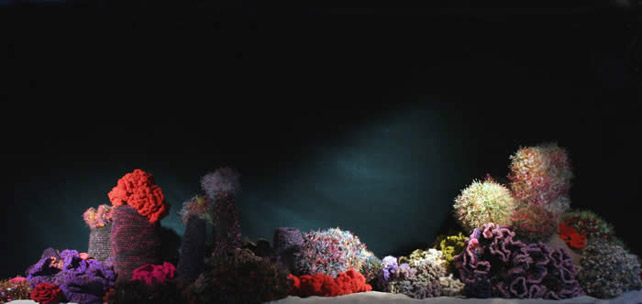
It reminds me a bit of the Hyperbolic Crochet Coral reef
http://www.arizonafoothillsmagazine.com/valleygirlblog/wp-content/uploads/crochet-coral-reef-project.jpg

The Hyperbolic Crochet Coral reef is a woolly celebration of the intersection of higher geometry and feminine handicraft, and a testimony to the disappearing wonders of the marine world.
Created and curated by Christine Wertheim and Margaret Wertheim of The Institute For Figuring
Hyperbolic Crochet was invented by Daina Taimina.
One of the acknowledged wonders of the natural world, the Great Barrier Reef stretches along the coast of Queensland, Australia, in a riotous profusion of colour and form unparalleled on our planet. But global warming and pollutants so threaten this fragile monster that scientists now believe the reef will be devastated in coming years.
Christine Wertheim and Margaret Wertheim grew up in Queensland. The project began in2005 in Los Angeles and for four years the Reef took over their house. At the same time the project began to expand into other cities and countries until it became a worldwide movement that engaged communities across the globe. The crochet Reef is a unique fusion of art, science, mathematics, handicraft and community practice that may well be the largest art project in the world.

Sunday, August 29, 2010

Conversation Pieces


Years ago I watched Nursing change its core base of process and procedure to outcome based. All brought about by thinking people. Whilst nurses had their heads down working in blind obedience, the thinkers thought. Elizabeth Kubler Ross ( Loss and Grief) is just one example-she asked the question, ‘what about that person sitting so neatly in crisp sheets with fluffed up pillows ; so well looked after, but did anyone think or have the understanding to approach the subject of dying. The person was dying; however the subject was invisible, too delicate to approach. A new holistic genre was soon to come into being. The person was not one to be observed and pitied and ‘keep comfortable’. The person was human and could have control over their life; many major reforms took place. It was the beginning of the dialogue of change, culminating today with client based approached to health care. I hesitate at this point to make comment on the health system of today. Even though there has been a mammoth leap in technology the politics and the humanity issues still cross paths, (our desperate struggle; the person the penny) all institutions have their hierarchical structure and there is no one answer. The ‘state’ is untimely in control and if you spend the Queen’s penny you do her bidding- the dialogue is continuing. Grant Kester’s book ‘Conversation pieces’ reminds me of this same process.
In art I am seeing a divide; some artists create by doing and use object/image base, others, the thinkers, who base practice on idea/ideal. However, at a deeper level most artists are socially and political minded at heart. I hadn’t really noticed or understood this concept until pouring over Grant H. Kester words in regard to WochenKlausur’s art collective’s ’ boat colloquies’.
‘...creative act a concrete intervention in which the traditional art materials of marble canvas or pigment were replaced by “socio-political relationships”
‘...creative facilitation of dialogue and exchange’
‘...conversation becomes an integral part of the work itself. It is reframed as an active, generative process that can help us speak and imagine beyond the limits of identities, official discourse, and the perceived inevitability of partisan political conflict’
‘The work of art can elicit a more open attitude toward new and different forms of experience while challenging the assumption that avant-garde art must be shocking or difficult to understand’
For example ‘context providers rather than content providers’
Ed Kienholz and Nancy Reddin Kienholz


The ‘Hoerengrachts’ is described as a remarkable work of contemporary art that serves as a social commentary, a statement of political intent.
The Hoerengrachts is a street scene in three dimensions and depicts a street in Amsterdam’s red light district; it portrays prostitutes and their working premises.
First exhibited in 1984


http://www.theleisurereview.co.uk/images/Keinholz%20S033.pr.jpg
The distinction between these art works is the outcome; whereas ‘Hoerengrachts’ is labelled a historical record: WochenKlausur’s reached a positive and concrete response to the problem.
A “creative act a concrete intervention” that has moved away from the institution. Some critics question if this is art as it is ‘indistinguishable from political or social activism’. I can only say that these Dialogical projects produced outcomes never reached or even thought of before as opposed to pure self orientated consumerism.

Sunday, August 22, 2010

Situationist International

The Situationist International’s (1957) practice seems a part of its own historical time, and responds more to a political environment then an art movement. By all accounts in ‘Constructing The Situation’ the continuum from Avant-gardist methods of Futurism, Dada, Agi-Theater seamlessly take root with all the elements of rebellion and anti authority. More perversive though is its power to provoke and disrupt the dictate of the order of that time. Art in a political guise or art responding to society and demanding change; itself becoming the propaganda machine in its dissemination of its theoretical views in the form of magazines, posters and film. There is a strong sense of its intent to wake up the passive observer and turn him into an active participant (Guy Debord’s Society of the Spectacle). The Situationists’ ideas are immortalized in their posters and cartoons and ultimately the art giving way to the theoretical writing and political organising culminating in the French general strike in of May 1968

Sunday, August 15, 2010

Michael Asher

Michael Asher

‘Asher Noted “Experience is all” ‘
‘Asher’s installations have engaged both individual and collective aspects of spectatorship, providing viewers pathways to self reflective situations where they can be intensely aware of their perceptual and cognitive processes in relation to their social setting as well as to themselves”
These words truly resonate with me; we all come with a uniqueness that will render any interpretation endless. However, as I read on I found this document intriguing, for when I felt comfortable I was hit with the opposite hypotheses.
‘Fried and Morris were not interested in the pre-existing qualities of the spectator...............instead both treated the beholder as a blank slate’ (late 60’s early 70’s). Now I begin to think this sounds very logical too. The pure sensations of Asher’s sensory spaces and his treatment of perception as in; painting one side of the room black and one side white remind me of Brigit Riley who played with the optic nerve continually -pure sensation. Read on;
‘Asher’s 1974 comment that he “(was) not interested in manipulating perception” came at the end of his sensory installation period, and served to distinguish his work ( which he defined as “situational”) from light and space “environments”. The viewing experience with which he wanted to associate his work now aimed to connect the sensory with the social sphere’.
Asher’s ‘Clocktower installation’ New York 1976, left one critic (Nancy Foote) with this observation
‘The art is pushing you around, sending you scrambling for its subliminal effects without having the courtesy to provide adequate cues. Once you make the outside / inside connections, you think you’ve got it. Then it dawns on you that the work is also about the process of making that connection. It comments on awareness itself by forcing you to think about how it ought to affect you’.
This is a very condensed comment as there are 34 pages; I have just chosen bits that appeal to me.

Saturday, August 7, 2010

Relational Aesthetics

I am mindless after reading;
Hal Foster, “Arty Party”.
Claire Bishop, “Antagonism and Relational Aesthetics”.
Liam Gillick, “Contingent Factors: A Response to Claire Bishop’s “Antagonism and Relational Aesthetics”.
Claire Bishop ‘Claire Bishop Responds”.
Nicolas Bourriaud, “Relational Aesthetics”.
The Preface to “The Art of Social Imagination, Collectivism after Modernism” (the book had to be returned as it was a week only loan).
Nicolas Bourriaud, “Postproduction” (up to page 33).
Multiples of images and information of artists (with thanks to the web).

Never have been fortunate enough to see any of the exhibitions of the artists discussed I am hesitant to proffer any opinion more over offer any critical response. However, after this sojourn into the world of the art critic I will respond from an observational point of view. The idea (Hal Foster) “these artists aim to turn passive viewers into a temporary community of active interlocutors” has yet to reveal its propensity to me as art form. The words ‘discursivity and sociability”, “a place of socialization” bandy themself around in particular to Tiravanija and Gillick and fall into Nicolas Bourriaud’s ‘Relational Aesthetics”. Art imitates life and vice a versa. If art is an engagement in critical thought these works may meet the mark. However, in reality, I could meet strangers or friends and engage socially at any time.
I have a leaning to concur with Claire Bishop and find Sierra and Hirschhorn more thought provoking. In all there is a historical rebellion of artists to question and refute the established order and art itself; as in the Dada’s response to war and meaning. Our present day’s response to the age of technological and dare I say, war and displacement mirrors just that and is a continuum.

Friday, July 30, 2010

transitivity

I should leave it to Duchamp to succinctly ameliorate this role of ‘spectator’.

'All in all, the creative act is not performed by the artist alone; the spectator brings the work in contact with the external world by deciphering and interpreting its inner qualification and thus adds his contribution to the creative act. This becomes even more obvious when posterity gives a final verdict and sometimes rehabilitates forgotten artists'
THE CREATIVE ACT. By Marcel Duchamp
Published in: Robert Lebel: Marcel Duchamp.
New York: Paragraphic Books, 1959, pp. 77/78.
http://radicalart.info/things/readymade/duchamp/text.html

I am just getting the point to transitivity ‘a relation between three elements such that if it holds between the first and second and it also holds between the second and third it must necessarily hold between the first and third’ and Bourdieu ‘relations between individuals and groups, between the artist and the world, and by way of transitivity, between the beholder and the world.'

I should leave it there for I know there are others with more knowledge than me. I am feeling very like ‘Alice’ falling down the rabbit hole. I look forward to the class discussion.

Carmel Wellburn